Stryker Laparoscopic Camera Price in India 2025 — Advanced Guide to 1488, 1588 & 1688 4K Laparoscopy Set, Tower & Catalog
Everything your hospital needs to know about Stryker laparoscopic camera price in India — Stryker laparoscopy 1588 price, Stryker laparoscopy 1688 price, complete Stryker laparoscopy set pricing, Stryker laparoscopy tower configuration, and how to access the Stryker laparoscopic instruments catalog PDF and Stryker 1488 camera brochure. Written for surgeons, OT managers, and hospital purchase committees.
What is the Stryker Laparoscopic Camera?
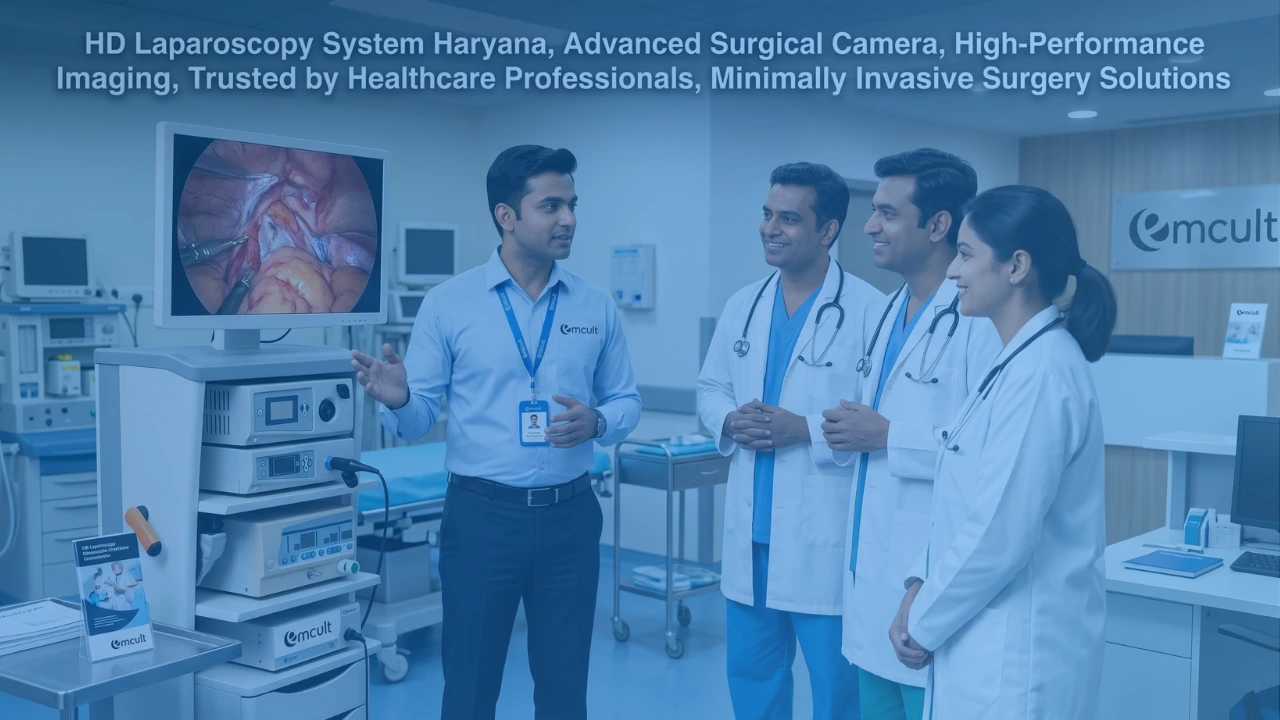
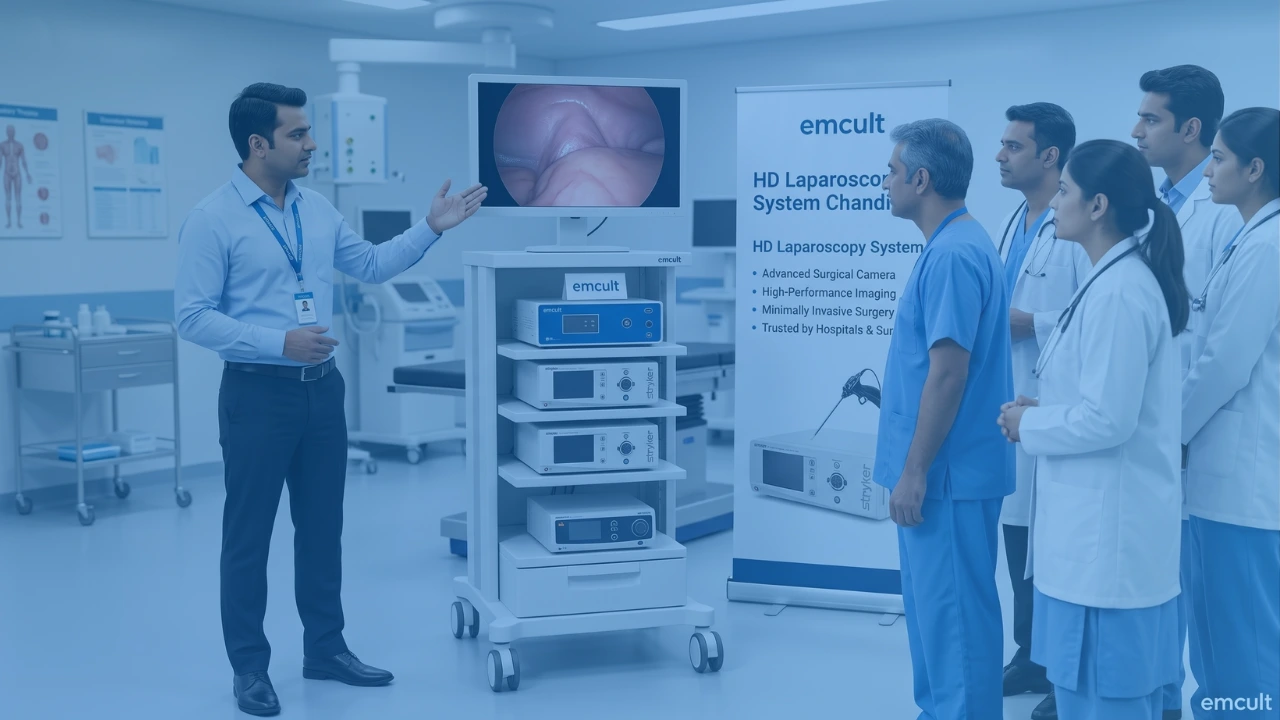
The Stryker laparoscopic camera is the world’s most widely used advanced surgical visualization system for minimally invasive surgery. Made by Stryker Corporation — a global medical technology company headquartered in Kalamazoo, Michigan, USA — the Stryker laparoscopic camera range includes the 1488 HD, 1588 AIM, and 1688 4K AIM platforms. In India, the Stryker laparoscopy price for certified pre-owned systems from Emcult starts at ₹5 lakhs for entry-level systems and goes up to ₹40 lakhs for the complete 4K AIM laparoscopy set — making it accessible to hospitals at every budget level across all 28 states.
What sets the Stryker laparoscopic camera apart from other brands is its AIM (Advanced Imaging Modality) platform — a set of five specialized imaging modes that go far beyond standard HD visualization. The most clinically important AIM mode is ENV (Endoscopic Near-infrared Visualisation), which uses ICG fluorescence dye to make bile ducts glow green during cholecystectomy — directly preventing one of laparoscopic surgery’s most serious complications. The IRIS mode makes ureters visible through the peritoneum during hysterectomy. These safety-enhancing modes are the main reason India’s top hospitals — AIIMS, Apollo, Fortis, Max, Medanta — have standardized on the Stryker laparoscopic camera platform.
Why the Stryker laparoscopic camera is India’s top choice
- Advanced imaging safety: ENV and IRIS modes prevent high-cost, high-risk intraoperative complications that standard cameras cannot prevent
- 9 specialty presets on one CCU: One Stryker camera console covers laparoscopy, arthroscopy, urology, gynecology, ENT, and more — saving ₹20–40 lakhs in separate cameras per department
- Best India serviceability: Stryker has the widest service network, most trained biomedical engineers, and largest spare parts inventory in India of any laparoscopic camera brand
- Emcult accessibility: Certified pre-owned Stryker cameras from Emcult make this world-class technology available to Indian hospitals at 40–70% below new price
Types of cameras used in laparoscopy — overview
There are several types of cameras used in laparoscopy, varying by technology, chip count, resolution, and advanced imaging capability. Understanding these types helps you choose the right system for your surgical department:
- Most popular India: HD 3-chip CMOS camera
- Premium option: 4K UHD surgical camera
- Advanced specialty: 3D laparoscopic camera
- Budget option: Single-chip HD camera
- With fluorescence: NIR / ICG AIM camera
- Flexible scope: Chip-on-tip camera
The 3-chip HD camera — India’s most used laparoscopy camera
The vast majority of modern laparoscopy in Indian hospitals uses a 3-chip HD CMOS camera system — typically from Stryker, Karl Storz, or Olympus. Three separate image sensors (one each for Red, Green, and Blue colour channels) produce exceptionally sharp, accurate-colour full HD 1920×1080 images. This gives the surgeon the most realistic, detailed view of abdominal anatomy. The market leaders — the Stryker laparoscopic camera 1588 AIM and STORZ laparoscopic camera IMAGE1 S — are both 3-chip HD CMOS systems.
Why 3-chip cameras outperform single-chip systems in laparoscopy
A single-chip camera uses one sensor for all three colours (using a Bayer filter). While adequate for basic procedures, single-chip cameras produce more colour noise, less accurate tissue colour rendering, and poorer performance in low-light conditions inside the abdomen. For complex surgery — hepatobiliary, bariatric, oncological, or gynecological — 3-chip cameras provide a significant clinical safety advantage through superior image quality.
Quick comparison: camera types used in laparoscopy
| Camera type | Resolution | Best for | India price range |
|---|---|---|---|
| 3-chip HD CMOS Most popular | 1920×1080p | All complex laparoscopy | ₹8–25L refurbished |
| 4K UHD laparoscopic | 3840×2160p | Oncology · Complex GI | ₹20–38L refurbished |
| 3D laparoscopic | HD 3D stereo | Suturing · Training | ₹22–40L refurbished |
| Single-chip HD | 720p–1080p | Basic procedures | ₹1.5–6L new |
2. Laparoscopic Camera Parts — Every Component Explained
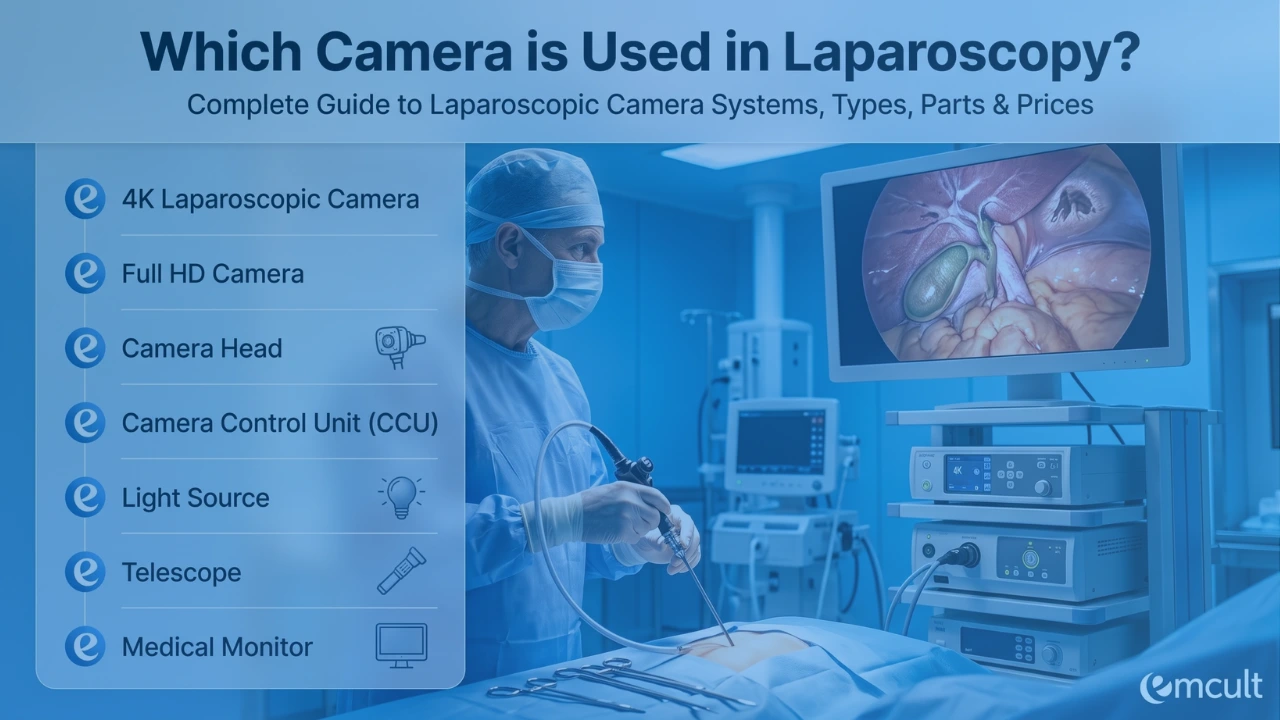
Understanding the laparoscopic camera parts helps surgeons, OT nurses, biomedical engineers, and purchase committees specify the right equipment and troubleshoot problems during procedures. A complete laparoscopic camera system consists of six main parts — all of which must work together for the best image quality.
- Camera Head (Attached to the scope eyepiece): The camera head is the handheld component that the scrub nurse clips onto the eyepiece of the laparoscope in the operating room. It contains the CMOS or CCD image sensors (1 or 3 chips), 4 programmable function buttons, a focus ring, and the cable connector to the CCU. It must be waterproof (IPX7 rated) to survive cleaning and sterilization. In the Stryker system, the laparoscopic camera parts list shows 4 camera head types: Standard C-Mount, Inline, Pendulum (90°), and Integrated Coupler heads.
- Camera Control Unit (CCU) (The processing brain of the system): The CCU is the central processing unit that receives the raw video signal from the camera head, applies colour correction, white balance, noise reduction, and any advanced imaging modes (AIM, SPIES, NBI), and outputs the final HD or 4K video to the surgical monitor. It has a touchscreen interface for specialty preset selection, brightness control, and AIM mode activation. The Stryker 1588 AIM CCU (Part No. 1588010000i) and STORZ laparoscopic camera IMAGE1 S hub are examples of the CCU component.
- Coupler / Adaptor (Connects camera head to scope): The coupler (also called adaptor or C-Mount coupler) connects the camera head body to the laparoscope eyepiece. It contains a zoom lens that the scrub nurse turns to set the correct image size and parfocal focus before the scope enters the patient. The coupler must precisely align the camera sensor with the scope’s optical axis for a sharp, undistorted image. The Stryker “Ideal Eyes HD Zoom Coupler” and Karl Storz H3-Z camera adaptors are standard coupler components in their respective systems.
- Laparoscope (telescope) (The rigid optical tube inserted in the body): While technically a separate instrument, the laparoscope is the optical component that works directly with the camera. It is a rigid Hopkins rod-lens telescope — available in 0°, 30°, 45°, and 70° viewing angles, and 5mm or 10mm diameters. The laparoscope transmits the magnified image from inside the abdomen to the camera head attached at its eyepiece. The 10mm 30° laparoscope is the most commonly used scope in general laparoscopy in India. Laparoscopes from STORZ laparoscopic camera systems are compatible with any major-brand camera system using the appropriate coupler.
- Light Source + Light Cable (Illumination for the surgical field): The light source generates powerful bright light (LED or xenon) that travels through a fiber optic light cable into the scope’s light post, illuminating the dark interior of the abdominal cavity. Modern LED light sources (like the Stryker L10 LED) are significantly better than older xenon sources — they require no bulb replacement, have consistent output throughout their life, and include Safelight technology for patient safety. The light source is a critical laparoscopic camera parts component — poor light output directly reduces image quality regardless of how good the camera sensors are.
- Surgical HD Monitor (High-brightness OR display): The surgical monitor is a medical-grade, high-brightness display that shows the surgeon the live camera image throughout the procedure. Unlike consumer TVs, surgical monitors are calibrated for accurate tissue colour reproduction, have minimal video latency (no perceptible lag between scope movement and screen update), and are rated for the high ambient light and disinfection requirements of an operating room. The Stryker VisionPro LED Monitor and Karl Storz documentation display systems are examples of dedicated surgical monitors that complete the laparoscopic camera system.
OT staff tip: Before every procedure, check all laparoscopic camera parts for physical damage — inspect the camera head cable jacket for kinks, check the light cable for broken fibers (appear as dark dots at the cable tip), verify the coupler focus ring moves smoothly, and always perform white balance after connecting the camera head to the scope.
3. Laparoscopic Camera Size — Scope Diameters and Camera Head Dimensions
The laparoscopic camera size question typically refers to the diameter of the laparoscope (telescope) that the camera head is attached to — and sometimes to the profile of the camera head itself. Laparoscopic camera size directly affects patient comfort (smaller scopes mean smaller port sites and less trauma), image quality (larger scopes transmit more light), and the type of procedure it can be used for. Here is a complete guide to laparoscopic camera size options:
Camera head profile — why laparoscopic camera size matters in the OR
Beyond the scope diameter, the laparoscopic camera size also refers to the physical profile of the camera head itself. A bulky camera head creates leverage and torque on the scope inside the patient — particularly problematic during long procedures or when operating in tight anatomical spaces. Camera head manufacturers (Stryker, Karl Storz, Olympus) have progressively miniaturized their camera heads to reduce this problem.
The Stryker Inline camera head — used for arthroscopy and small-space laparoscopy — has a significantly lower profile than the standard C-Mount head, reducing scope leverage and making it more ergonomic for the scrub nurse holding the camera. The Karl Storz H3-ZA TH104 autoclavable head is specifically designed with a compact form factor to minimize instrument crowding in the OT.
Recommended laparoscopic camera size by procedure type
| Procedure | Recommended scope size | Camera head type |
|---|---|---|
| Laparoscopic cholecystectomy | 10mm 30° | Standard C-Mount |
| Laparoscopic hysterectomy | 10mm 0° or 30° | Standard C-Mount |
| Laparoscopic appendectomy | 10mm 30° | Standard C-Mount |
| Bariatric (sleeve / bypass) | 10mm 30° | Standard C-Mount |
| Pediatric laparoscopy | 5mm 30° | Inline / low-profile |
| Diagnostic laparoscopy | 5mm or 10mm 0° | Standard C-Mount |
| Laparoscopic colorectal | 10mm 30° + 10mm 70° | Standard C-Mount |
4. Laparoscopic Camera Holder & Holding Skills — Essential Guide for OT Teams
Two of the most important practical topics for OT teams are the laparoscopic camera holder — the device or person that holds the camera during surgery — and laparoscopic camera holding skills — the technique used to provide the surgeon with a stable, well-oriented view throughout the procedure. Poor camera holding is one of the most common causes of surgical difficulty in laparoscopy training — so getting these skills right is critical for every OT team member who handles the camera.
Types of laparoscopic camera holder
A laparoscopic camera holder can be either a human assistant or a mechanical/robotic device. Both types are used in Indian hospitals:
- Human camera assistant Standard — most common: A trained scrub nurse or surgical resident holds the laparoscope throughout the procedure. This is the most common laparoscopic camera holder method in India. Requires good laparoscopic camera holding skills including steady hands, correct scope orientation, and responsiveness to the surgeon’s verbal directions.
- Mechanical scope holder Robotic arm — no assistant needed: A mechanical laparoscopic camera holder arm clamps to the OR table rail and holds the scope steady without human assistance. The Stryker Wingman Pneumatic Scope Holder — integrated with the Stryker 1588 and 1688 camera heads via a dedicated button — allows the surgeon to drive the camera position using a camera head button or foot pedal. Eliminates scope drift and assistant fatigue in long procedures.
- Voice-controlled robotic holderAdvanced — voice commands: Advanced robotic laparoscopic camera holder systems (e.g., EndoAssist, AutoLap) respond to the surgeon’s head movements, voice commands, or gaze direction to move the scope to a desired position. Used in single-surgeon laparoscopy setups. Growing adoption in high-volume laparoscopy centers across India.
- Robotic (da Vinci / laparoscopic robot) Robotic surgery: In robotic laparoscopic surgery, the camera arm of the robotic system holds and drives the scope — controlled by the surgeon from the robot console. The camera in robot-assisted laparoscopy uses a 3D HD camera system at the scope tip rather than an externally attached camera head. Available in major corporate hospitals in Delhi, Mumbai, Bengaluru, and Chennai.
Laparoscopic camera holding skills — the 8 essential rules every OT nurse must know
Good laparoscopic camera holding skills are the foundation of safe, efficient laparoscopic surgery. A nurse or resident who holds the camera steadily, in the correct orientation, and responsive to the surgeon’s needs makes every procedure faster and safer. Here are the 8 essential laparoscopic camera holding skills every OT team member must master:
- Horizon rule — keep the image level: The most fundamental of all laparoscopic camera holding skills. The horizon line in the laparoscopic image should always be horizontal — liver at the top, bowel below. A tilted image is disorienting for the surgeon and slows the procedure. Before every case, set the camera head rotation on the coupler so the horizon is level, then lock the coupler ring.
- 2Keep the operating instruments centred on screen: The camera holder must anticipate the surgeon’s movements and keep the working instruments (grasper, dissector, clipper) in the central third of the screen. Instruments disappearing off the edge of the image is a dangerous loss of the surgeon’s situational awareness.
- Avoid scope touching abdominal wall or organs: The scope tip must always be kept clear of the abdominal wall, bowel, and vascular structures. Pressing the scope tip against tissue causes image blur, damages the scope optics, and can cause bowel trauma. Develop the spatial awareness to feel when the scope is too deep before looking at the screen.
- Steady two-hand grip for zero drift: Always hold the scope with both hands — one hand near the port site providing the primary grip, one hand farther up the scope shaft providing fine directional control. Never hold the scope with one hand — single-hand holding causes scope drift that distracts the surgeon and accumulates fatigue injuries in the holder.
- Learn the 30° scope rotation technique: With a 30° angled laparoscope, rotating the scope shaft changes the viewing direction — the light post on the scope points opposite to the direction of view. Learning to rotate the scope to look around structures (without pointing the camera head in the “wrong” direction) is an advanced laparoscopic camera holding skill that dramatically improves visibility.
- Scope fogging — prevention and clearing: The scope tip fogs when cold scope meets warm body cavity air. Prevention: warm the scope tip in warm saline or on the patient’s skin for 30 seconds before entry. Treatment: gently touch the scope tip to the nearest abdominal wall or peritoneum (fat wipes the lens clean) — or use an anti-fog solution pre-operatively applied to the scope lens
- Respond immediately to surgeon’s verbal cues: A skilled camera holder responds immediately to surgeon instructions — “look up,” “pull back,” “come left,” “zoom in” — without overmoving. Small, precise adjustments keep the surgical field stable. Good communication between surgeon and camera holder is one of the most underrated factors in efficient laparoscopic surgery.
- Use the mechanical camera holder for long cases: For procedures longer than 90 minutes, consider switching to a mechanical laparoscopic camera holder (Stryker Wingman or equivalent). Human fatigue in the camera holder causes scope drift that accumulates over time — a mechanical arm holds the camera perfectly still without fatigue, improving image stability and freeing the human assistant for other tasks.
5. Top Laparoscopic Camera Brands in India — Stryker, STORZ, Olympus Compared
When asking which camera is used in laparoscopy in leading Indian hospitals, three global brands dominate: Stryker, Karl Storz, and Olympus. Here is a complete, honest comparison for health professionals evaluating a new or refurbished laparoscopic camera purchase:
Stryker (USA)
USA · Global surgical technology leader The Stryker laparoscopic camera range — particularly the 1588 AIM and 1688 4K AIM — is the most widely deployed advanced laparoscopic camera in India. Unique AIM imaging modes (ENV bile duct mapping, IRIS ureteral protection, DRE, Clarity) provide clinical safety advantages that go beyond standard HD imaging. 9 specialty presets on one CCU make it the go-to platform for multi-specialty hospitals. The Stryker laparoscopic camera price in India for a refurbished 1588 AIM CCU starts at ₹8 lakhs; complete refurbished set starts at ₹14 lakhs. Refurbished: ₹8–38L · New: ₹25–80L
Karl Storz (Germany)
Germany · Precision optics specialist The Stryker laparoscopic camera range — particularly the 1588 AIM and 1688 4K AIM — is the most widely deployed advanced laparoscopic camera in India. Unique AIM imaging modes (ENV bile duct mapping, IRIS ureteral protection, DRE, Clarity) provide clinical safety advantages that go beyond standard HD imaging. 9 specialty presets on one CCU make it the go-to platform for multi-specialty hospitals. The Stryker laparoscopic camera price in India for a refurbished 1588 AIM CCU starts at ₹8 lakhs; complete refurbished set starts at ₹14 lakhs. Refurbished: ₹5–14L · New: ₹18–45L
Olympus (Japan)
Japan · Endoscopy pioneer The Olympus laparoscopic camera range brings Japan's world-leading endoscopy optics expertise to surgical visualization. Known for natural colour reproduction, NBI technology, and integration with Olympus's flexible endoscope ecosystem. The Visera Elite II and CLV-S190 are the leading Olympus laparoscopic camera systems in India. Laparoscopy camera price in India for Olympus refurbished sets starts at ₹7 lakhs. Particularly valued in GI endoscopy–laparoscopy combined departments. Refurbished: ₹6–20L · New: ₹15–40L
When to choose each brand
Decision guide for Indian hospitals Choose Stryker 1588 AIM for: ENV/IRIS advanced imaging needs, multi-specialty OT standardization, highest India market serviceability, best all-round value. Choose STORZ laparoscopic camera for: no Sterrad available (autoclavable head), NBI-equivalent urology (SPECTRA), German optics preference. Choose Olympus for: combined GI endoscopy + laparoscopy departments, NBI for GI cancer detection, Japanese build quality preference. All available pre-owned at Emcult · Free comparison consultation
6. Laparoscopy Camera Price in India 2025 — Complete Guide
The laparoscopy camera price in India varies significantly across brands, technology types, and new vs refurbished purchase. This complete 2025 price guide helps hospital purchase committees and individual surgeons plan their budget accurately. All laparoscopy camera price figures below include a complete set (CCU + light source + camera head + monitor) unless stated otherwise:
Stryker laparoscopic camera price in India 2025
The Stryker laparoscopic camera price in India spans a wide range based on system generation. The Stryker laparoscopic camera price in India for a complete 1588 AIM bundle (CCU + L10 LED + VisionPro monitor + Standard camera head) is ₹14–25 lakhs for a certified refurbished system from Emcult, compared to ₹35–45 lakhs for new equipment. Here is the full Stryker price spectrum for Indian hospitals:
| Stryker system | New price India | Refurbished — Emcult | Savings |
|---|---|---|---|
| Stryker 1488 HD complete set | ₹10–18L | ₹5–9L | ~50% |
| Stryker 1588 AIM CCU only Most popular | ₹18–25L | ₹8–15L | ~50–55% |
| Stryker 1588 AIM complete set | ₹35–45L | ₹14–25L | ~45–55% |
| Stryker 1688 4K AIM CCU only | ₹40–55L | ₹18–35L | ~50–60% |
| Stryker 1688 4K AIM complete set | ₹60–80L | ₹25–40L | ~50–60% |
STORZ laparoscopic camera price and other brands
The laparoscopy camera price in India for a STORZ laparoscopic camera IMAGE1 S system ranges from ₹6–14 lakhs refurbished to ₹20–35 lakhs new for a complete set. Olympus laparoscopic camera complete set: ₹7–20 lakhs refurbished / ₹15–40 lakhs new. All prices are indicative — contact Emcult at +91 9717887658 for a current quotation with GST breakup.
Saving tip: A certified refurbished laparoscopic camera from Emcult saves 40–70% compared to new equipment — with identical clinical performance. Every refurbished system comes with a 28-point inspection certificate, functional warranty, free installation, free staff training, and a 30-day trial period. This is the smarter way for Indian hospitals to access world-class surgical visualization technology within realistic capital budgets.
7. New vs Refurbished Laparoscopic Camera — Which Should You Buy?
One of the most common questions from Indian hospital purchase committees is whether a new or refurbished laparoscopic camera is the right choice. The short answer: for most Indian hospitals — a certified refurbished camera from a trusted supplier like Emcult is the smarter choice. Here is an honest comparison:
Why certified refurbished laparoscopic cameras are trusted by 200+ Indian hospitals
- Same clinical performance: A properly inspected and certified refurbished laparoscopic camera produces identical image quality to a new system — the CMOS sensors, optical components, and image processing circuitry perform identically if they pass the quality inspection
- 40–70% cost savings: The most compelling reason. A ₹35 lakh Stryker 1588 AIM set becomes ₹14–18 lakhs — freed capital that can be directed to additional OT equipment, staffing, or hospital infrastructure
- Faster availability: New Stryker, STORZ, or Olympus systems ordered from official distributors often have 4–8 week delivery timelines. Emcult’s refurbished inventory is available for same-day to 2-week delivery across India
- Emcult’s 28-point inspection: Every refurbished system passes image quality, electrical safety, mechanical, and functional tests before leaving our Noida facility — backed by a written inspection certificate
- GEM/DGSND compliant: Government hospitals can procure refurbished laparoscopic cameras from Emcult through GEM portal with full compliance documentation
Warning: Not all "refurbished" laparoscopic cameras are equal. Some unverified suppliers sell used equipment without proper inspection or warranty — leading to camera failures in the operating room. Always buy from a supplier who provides a written inspection certificate, IEC 60601-1 electrical safety test report, and a documented warranty period. Emcult provides all three with every unit.
For clinical guidance, the Association of Minimal Access Surgeons of India (AMASI) recommends that all hospitals running laparoscopic surgery programs ensure their camera systems meet minimum HD resolution and functional standards — whether new or refurbished. Emcult’s certified refurbished inventory meets and exceeds these standards.
8. Frequently Asked Questions — Which Camera is Used in Laparoscopy?
Which camera is used in laparoscopy in India's best hospitals?
What are the main laparoscopic camera parts I need to know?
What is the laparoscopic camera size used in most Indian hospitals?
What is the Stryker laparoscopic camera price in India?
What is a laparoscopic camera holder and do I need one?
How do I improve my laparoscopic camera holding skills?
Conclusion — Which Camera is Used in Laparoscopy? The Final Answer
So — which camera is used in laparoscopy? The answer is: a high-definition 3-chip CMOS laparoscopic camera system — most commonly from Stryker 1588 AIM or 1688 4K AIM, Karl Storz (STORZ laparoscopic camera IMAGE1 S), or Olympus (CLV series) — is the standard in India’s modern operating rooms. The complete system includes the camera head, camera control unit, coupler, light source, laparoscope, and surgical monitor — all working together to give surgeons a clear, accurate, real-time view inside the patient’s body during minimally invasive surgery.
Understanding the laparoscopic camera parts, the right laparoscopic camera size for each procedure, good laparoscopic camera holding skills, and the right choice of laparoscopic camera holder — mechanical or human — all contribute to safer, more efficient surgical outcomes for patients across India.
Whether you are evaluating a laparoscopy camera price in India for a new hospital OT, looking for the best Stryker laparoscopic camera price in India, comparing STORZ laparoscopic camera options, or exploring certified refurbished systems at 40–70% below new price — Emcult is India’s most trusted pre-owned surgical camera partner. Call us today at +91 9717887658 for free expert advice, a no-obligation price quotation, and a 30-day trial at your hospital.
We Delivered Laparoscopic Surgical Camera in Pan India:
- HD Laparoscopy System in Delhi NCR
- HD Laparoscopy System in Pryagraj
- HD Laparoscopy System in Bhadohi
- HD Laparoscopy System in Varanshi
- Laparoscopy System in Punjab
- HD Laparoscopy System in Mumbai
- HD Laparoscopy System in Bengaluru
- HD Laparoscopy System in Chennai
- HD Laparoscopy System in Hyderabad
- HD Laparoscopy System in Haryana
- HD Laparoscopy System in Kolkata
- HD Laparoscopy System in Lucknow
- HD Laparoscopy System in Jaipur
- HD Laparoscopy System in Ahmedabad
- HD Laparoscopy System in Pune
- HD Laparoscopy System in Chandigarh
- HD Laparoscopy System in Bhopal
- HD Laparoscopy System in Guwahati
- HD Laparoscopy System in Kochi
- HD Laparoscopy System in Bhubaneswar